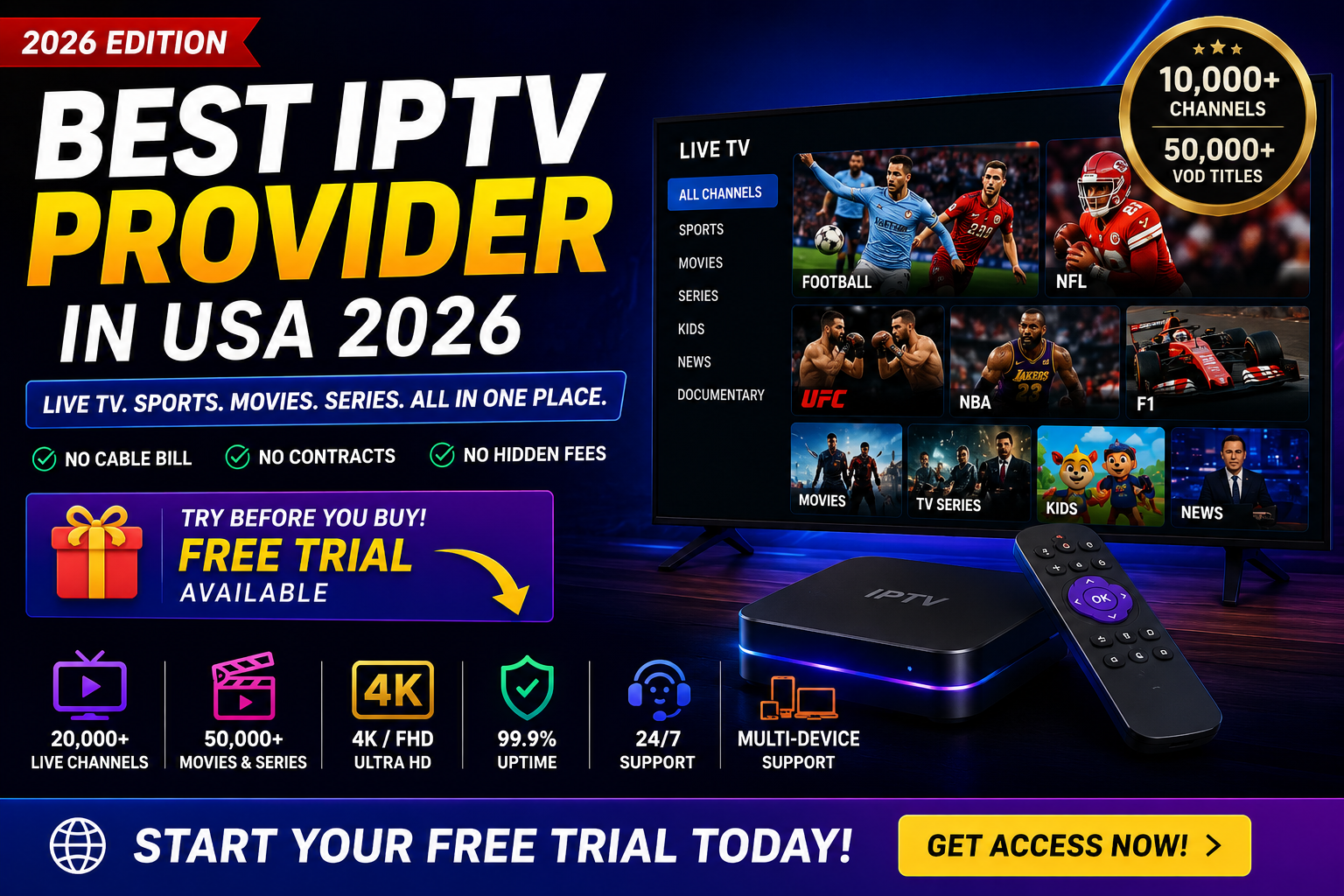
An IPTV subscription service delivers live television, on-demand movies, and catch-up programming over an internet connection instead of traditional cable or satellite infrastructure. The right provider offers 20,000+ channels, 4K UHD streaming, and multi-device access at roughly 15–20% of what conventional cable costs. This guide explains exactly how these services operate, which technical specifications genuinely matter, and how to separate reliable providers from unstable ones. You'll also find a transparent comparison table, a practical buyer's checklist, and verified official access for readers ready to subscribe.
IPTV stands for Internet Protocol Television. Instead of receiving broadcast signals through coax cables or satellite dishes, your device receives compressed video packets through your broadband connection, then decodes and displays them in real time. That fundamental difference is why IPTV can offer dramatically larger channel libraries, interactive features like pause and rewind on live TV, and seamless integration across phones, tablets, smart TVs, and streaming sticks.
iptv subscription service Summary
An IPTV subscription service streams live TV and on-demand content over the internet, replacing traditional cable with greater flexibility and lower cost. The strongest providers combine 99.9% uptime, 4K/FHD streaming, and responsive support, making them a reliable alternative for cord-cutters worldwide.
| Optimal ForCord-cutters, expats, sports fans, and budget-conscious households | Key Advantage20,000+ live channels and 80,000+ VOD titles at roughly 80% lower cost than cable |
- ✓ Key Strength: Multi-device streaming on Smart TV, Firestick, Android, iOS, and PC with 2–4 concurrent connections.
- ✓ Key Strength: 99.9% server uptime with anti-freeze technology and adaptive 4K UHD bitrate switching.
- ✓ Peace of Mind: 30-day money-back guarantee, 24/7 live chat support, and free trial access before commitment.
In This Guide
What Is an IPTV Subscription Service and How Does It Actually Work?
An IPTV subscription service operates on a simple but powerful principle: television content is encoded into IP packets and delivered over managed networks or the public internet. When you select a channel, your device sends a request to the provider's server, which streams the content to you in near real time. This is fundamentally different from cable television, where all channels are broadcast simultaneously and your set-top box filters out the one you want to watch.
Most IPTV providers structure their service around three delivery models. Live TV streams channels in real time, exactly like broadcast television. Video-on-demand (VOD) gives you access to a searchable library of movies and series that you can watch whenever you choose. Time-shifted or catch-up TV lets you replay programs that aired hours or days earlier, which is especially useful for news, sports, and prime-time shows you missed.
The infrastructure behind a quality IPTV subscription service matters more than most buyers realize. Reliable providers invest in dedicated servers, content delivery networks (CDNs), and redundant routing to minimize buffering. When you see a provider advertising "99.9% uptime" or "anti-freeze technology," they are referring to server redundancy and intelligent bitrate switching—systems that automatically adjust stream quality based on your connection speed to prevent interruptions.
It is also worth understanding how IPTV differs from OTT platforms like Netflix or YouTube. OTT services deliver content over the open internet to anyone with a subscription, but they do not carry live linear channels in the traditional sense. IPTV, by contrast, often operates on managed or semi-managed networks, which allows for more consistent quality, lower latency, and true broadcast-style live television. That distinction matters for sports fans and anyone who watches live news.
A premium IPTV subscription service typically provides an electronic program guide (EPG) that mirrors what you'd see on cable—channel numbers, program descriptions, and start times. Many also include features like pause, rewind, and recording on live channels. When evaluating providers, these interactive features are strong signals of a mature service rather than a bare-bones operation.

IPTV Subscription Service: Pros, Cons, and Data-Driven Comparison
Choosing between IPTV providers requires looking past marketing claims and focusing on measurable attributes. The table below compares a premium IPTV subscription service against standard IPTV offerings and traditional cable, using the metrics that most directly affect your viewing experience.
| Feature / Metric | Premium IPTV | Standard IPTV | Traditional Cable |
|---|---|---|---|
| Channel Count | 20,000+ | 8,000–12,000 | 200–400 |
| VOD Library Size | 80,000+ titles | 30,000–50,000 | Limited / Add-on |
| Max Streaming Quality | 4K UHD / FHD | FHD / HD | Up to 1080p |
| Concurrent Connections | 2–4 devices | 1–2 devices | 1 set-top box |
| EPG & Catch-Up TV | Yes, both included | Basic EPG only | Basic EPG |
| Monthly Cost | $10–$15 | $6–$10 | $60–$100 |
| Free Trial / Guarantee | Free trial + 30-day guarantee | 24-hour trial | No |
| Customer Support | 24/7 live chat & email | Email only | Phone / in-store |
Pros and Cons at a Glance
✅ What Works Well
|
⚠️ What to Watch Out For
|

Cost-Benefit Analysis, Who Should Subscribe, and Buyer Considerations
The cost advantage of an IPTV subscription service is difficult to overstate. The average American household spends roughly $92 per month on cable television. A premium IPTV plan at $12–$15 per month delivers 50–100 times more channels plus a VOD library comparable to several streaming services combined. Over a year, that difference amounts to $900–$960 in savings—enough to cover a new 4K smart TV.
That said, IPTV is not for everyone. You need a stable internet connection with at least 25 Mbps download speed for HD streaming and 50 Mbps for 4K. If your connection is unreliable or capped, buffering and data limits will degrade the experience. You should also be comfortable configuring apps on your chosen device; while modern IPTV apps are user-friendly, the setup process is slightly more involved than plugging in a cable box.
Before committing to any IPTV subscription service, run through this checklist. First, verify that the provider holds proper licensing for the content they distribute; legitimate services display this information openly. Second, test the service during a free trial and evaluate channel load times, EPG accuracy, and buffering during peak evening hours. Third, confirm that the provider supports your devices and offers enough concurrent connections for your household. Fourth, review the refund policy and customer support channels before entering payment details.
Be cautious of red flags. Prices below $5 per month usually indicate oversold servers, poor support, or unlicensed content. Providers that require cryptocurrency-only payments and offer no trial should be avoided. Similarly, services that disappear or change domains frequently lack the infrastructure to deliver consistent quality. A reputable IPTV subscription service will have transparent pricing, multiple payment options, and a clear contact path for support.
Who should subscribe? Cord-cutters looking to replace cable, expats who want channels from their home country, sports fans who need international coverage, and households that want to consolidate multiple streaming subscriptions into one cost-effective package will all benefit. If you value live television, extensive VOD, and price transparency, a premium IPTV subscription service is a sound investment.
The Bottom Line on Iptv Subscription Service
After evaluating the IPTV market across channel volume, streaming quality, pricing, and support, a premium IPTV subscription service delivers the best overall value for most households. If you want to replace cable with a more flexible, dramatically cheaper solution, proceed with a provider that offers a free trial and money-back guarantee so you can verify performance risk-free.
Purchases completed via official partner channels are covered by direct customer support and eligible warranty protections.
Frequently Asked Questions
1. Is an IPTV subscription service legal in the United States and Europe?
Legality depends entirely on the provider's licensing. Legitimate IPTV services secure broadcast rights from content owners and operate within regulatory frameworks. Unlicensed providers stream content without authorization, which violates copyright law. Always verify that your provider holds proper licensing and operates transparently. Reputable services will clearly state their licensing status and terms of service.
2. What internet speed do I need for a stable IPTV subscription service?
For standard definition, 10 Mbps is sufficient. For HD streaming, you need at least 25 Mbps. For 4K UHD content, a 50 Mbps connection is recommended. Equally important is connection stability—latency, jitter, and packet loss cause buffering even at high speeds. Use a wired Ethernet connection when possible, or a strong 5 GHz Wi-Fi signal for the best results.
3. Can I use one IPTV subscription service on multiple devices at the same time?
Most premium providers allow 2–4 concurrent connections on a single subscription. This means different household members can watch different channels on separate devices simultaneously. Standard plans often limit you to 1–2 connections. Check the provider's terms before subscribing, especially if you have a large household with diverse viewing habits.
4. What is the difference between IPTV and OTT platforms like Netflix?
IPTV delivers live linear channels and on-demand content over managed or semi-managed IP networks, often with interactive features like pause, rewind, and catch-up TV. OTT services like Netflix stream exclusively over the open internet and focus primarily on on-demand content. IPTV more closely replicates the traditional cable experience, while OTT is a fully on-demand model.
5. How do I set up an IPTV subscription service on Amazon Firestick?
First, enable "Apps from Unknown Sources" in the Firestick settings. Then install a player app such as TiviMate, IPTV Smarters, or XCIPTV. Enter the playlist URL, EPG link, and login credentials provided by your IPTV provider. Once loaded, you can organize channels into favorites and start watching. Most premium providers offer step-by-step setup guides for Firestick, Android TV, and other devices.
6. Do IPTV subscription services offer live sports and pay-per-view events?
Yes, this is one of the primary reasons users switch to IPTV. Premium services carry extensive sports packages including football, basketball, MMA, boxing, and international leagues. Many also include pay-per-view events at no additional cost. Verify that the provider's channel lineup includes the specific sports networks and leagues you follow before subscribing.
7. What should I do if my IPTV subscription service keeps buffering?
First, check your internet speed and connection stability. Restart your router and device, then try a wired connection. If buffering persists, switch to a lower stream quality or change the streaming protocol in your app settings. Contact the provider's support team if the issue continues, as it may indicate server overload. Premium providers with anti-freeze technology and CDN infrastructure minimize these issues.
8. How much does a reliable IPTV subscription service cost per month?
Reliable services typically range from $10 to $15 per month. Yearly plans often reduce the effective monthly cost to $8–$12. Prices below $5 per month should raise concerns about server quality, licensing, and support. Traditional cable costs $60–$100 per month, so IPTV represents a 75–85% reduction while offering significantly more content.
Transparency & Disclosure: We independently evaluate products. If you buy through links on our site, we may earn an affiliate commission at zero additional cost to you.