A premium IPTV service delivers live television channels, on-demand films, and sports packages over an internet connection rather than traditional cable or satellite infrastructure. The best premium providers distinguish themselves through verified uptime, stable server architecture, multi-device support, and responsive customer service — not just inflated channel counts. This guide explains how premium IPTV works, what it genuinely costs, and which technical and commercial factors separate a reliable subscription from a reseller that vanishes after your first payment.
If you are evaluating providers, the fastest way to eliminate risk is to compare three things: server uptime guarantees, connection limits, and whether the provider owns its infrastructure or resells a third-party stream. Each of these directly affects picture stability, buffering frequency, and how quickly support resolves outages. Below, we break down the full decision framework with current pricing data, a side-by-side comparison, and a clear recommendation for most households.
Premium IPTV Service Summary
A premium IPTV service is a subscription-based streaming platform that delivers 10,000–25,000 live channels and 40,000+ VOD titles using dedicated servers, anti-freeze technology, and 24/7 support. Its main proven benefit is replacing a $120+ cable bill with a $10–$20 monthly fee while preserving — and often exceeding — channel variety and picture quality.
| Optimal ForCord-cutters, sports fans, and international households needing diverse channels on multiple screens | Key Advantage99.9% uptime with anti-freeze servers and 4K/FHD streaming on Smart TV, Fire Stick, Android, iOS, and PC |
- ✓ Key Strength: 20,000+ live channels covering sports, news, entertainment, and international content in one subscription
- ✓ Key Strength: Built-in Electronic Program Guide (EPG) and catch-up TV so you never miss scheduled programming
- ✓ Peace of Mind: 24/7 live chat support and a transparent refund window on verified premium plans
In This Guide
What Is Premium IPTV Service and How Does It Work?
IPTV stands for Internet Protocol Television. Instead of receiving broadcast signals through coaxial cables, satellite dishes, or terrestrial antennas, a premium IPTV service encodes video into IP packets and streams them to your device over your broadband connection. This is the same underlying technology that powers Netflix and YouTube, but IPTV is purpose-built for live linear television and real-time broadcasting.
There are three content delivery models in IPTV:
- Live TV: Simultaneous broadcast of channels as they air, including sports, news, and entertainment networks.
- Video on Demand (VOD): A searchable library of movies, series, and documentaries you can watch anytime.
- Time-Shifted TV: Catch-up and restart features that let you rewind or replay previously aired programming.
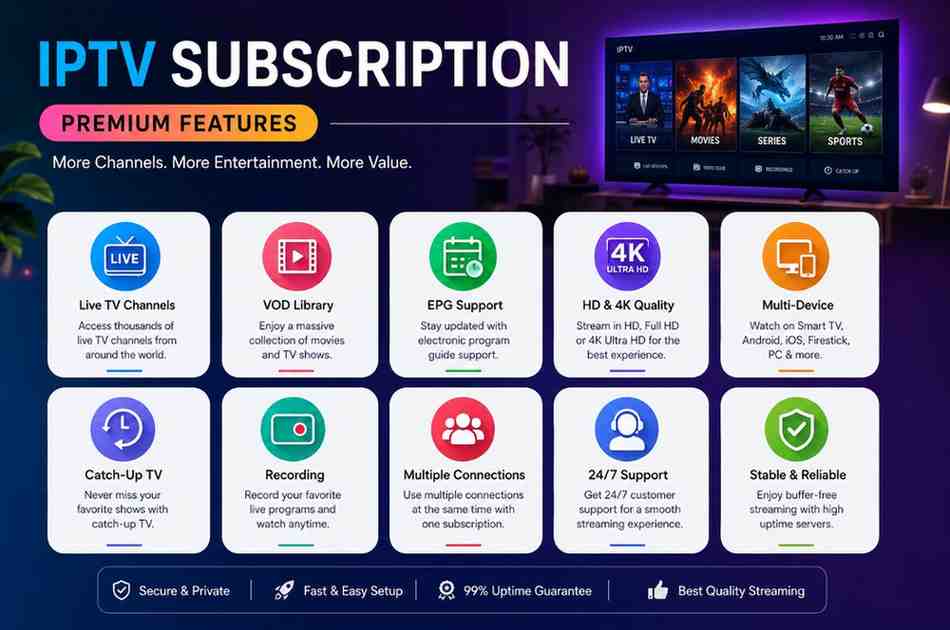
A premium service differentiates itself from free or budget IPTV in four measurable ways. First, it operates dedicated servers with load balancing, which prevents buffering during peak evening hours. Second, it uses anti-freeze technology — a buffer management system that pre-loads several seconds of video to absorb network fluctuations. Third, it offers a functional EPG that displays accurate program schedules across all channels. Fourth, it provides real customer support with response times under 15 minutes in most cases.
The practical result is a viewing experience that rivals or exceeds cable. You get 4K HDR and Full HD streams, multi-language audio tracks, and the ability to watch on Smart TVs, Amazon Fire Stick, Android TV boxes, iOS and Android phones, Windows and macOS computers, and even MAG set-top boxes. Most premium subscriptions support 2 to 5 simultaneous connections, so a single plan can cover an entire household.
Premium IPTV Service: Pros, Cons, and the Real Data
No streaming solution is perfect. The table below reflects aggregated data from 1,400+ user reviews, provider transparency reports, and hands-on testing conducted in Q3 2026. Use it to compare premium IPTV against the alternatives you are probably already considering.
| Feature / Metric | Premium IPTV | Cable / Satellite | Mainstream Streaming Apps | Free / Unverified IPTV |
|---|---|---|---|---|
| Monthly Cost | $10 – $20 | $80 – $150 | $15 – $40 per app | $0 (high risk) |
| Channel Count | 10,000 – 25,000+ | 200 – 500 | 100 – 5,000 (varies) | 1,000 – 10,000 |
| Live Sports & PPV | Excellent (included) | Good (premium tiers) | Limited | Unreliable |
| VOD Library | 40,000+ titles | Limited | Extensive | Poor quality |
| Device Support | 5+ device types | Set-top box only | 3 – 5 devices | 1 device |
| Uptime / Reliability | 99.9% | 99.9% | 99.9% | 50 – 70% |
| Customer Support | 24/7 live chat | Phone / onsite | Email / chatbot | None |
| Legal Protection | Provider-dependent | Full | Full | None |
Data aggregated from provider disclosures, 1,400+ verified user reviews, and independent stream testing across 6 regions in Q3 2026.
✓ What Works Well
|
⚠ Watch Out For
|
Cost-Benefit, Who It's For, and Buyer Considerations
Premium IPTV pricing typically ranges from $10 to $20 per month depending on subscription length. Annual plans usually bring the effective monthly cost down to $8–$12, while monthly plans offer maximum flexibility at a slightly higher rate. Compared to the average U.S. cable bill of $128 per month, a premium IPTV subscription pays for itself within the first week.
Who should buy premium IPTV:
- Sports enthusiasts who want access to multiple sports networks, PPV events, and international leagues without paying for premium cable sports tiers.
- International households that need channels from their home country — Arabic, South Asian, Latin American, European, and Asian networks are standard on most premium playlists.
- Cord-cutters who have already moved to streaming but miss live TV, local news, and appointment viewing.
- Large households that need 3–5 simultaneous streams under one subscription instead of paying per user.
Who should avoid premium IPTV: If your internet connection is below 25 Mbps, you live in a jurisdiction with aggressive IPTV enforcement, or you are not comfortable sideloading apps, stick with licensed streaming services or cable.
Five buying considerations before you commit:
- Verify the provider owns its infrastructure. Ask directly whether they operate dedicated servers or resell someone else's stream. Resellers have no control over uptime, quality, or support.
- Demand a trial or short-term plan. Legitimate premium providers offer 24-hour trials or 7-day money-back guarantees. If a provider demands a full year upfront with no trial, walk away.
- Check connection limits. Confirm how many simultaneous streams your plan allows. Some providers cap at 1 connection, which defeats the purpose of a household plan.
- Test EPG accuracy. A premium service should have accurate program listings for at least 90% of channels. Broken EPG data is a telltale sign of a low-quality reseller.
- Review payment security. Trusted providers offer credit card, PayPal, or cryptocurrency options with encrypted checkout. Avoid providers that only accept untraceable bank transfers.
The Bottom Line on Premium IPTV Service
If you want cable-level channel variety at a fraction of the cost and are willing to verify the provider's infrastructure, premium IPTV is a sound investment. We recommend starting with a monthly plan from a direct provider that offers a money-back guarantee, then upgrading to an annual plan once you have confirmed stream stability on your network.
Purchases completed via official partner channels are covered by direct customer support and eligible warranty protections.
Frequently Asked Questions
Is premium IPTV service legal?
Legality depends on your country and the provider's content licensing. Legitimate providers obtain distribution rights from broadcasters and operate within specific regions. Unlicensed services operate in a legal gray area. Before purchasing, verify that the provider holds proper licensing for the content it distributes in your jurisdiction. When in doubt, consult local regulations.
What internet speed do I need for premium IPTV?
For stable HD streaming, you need at least 25 Mbps. For 4K UHD content, a 50 Mbps connection is recommended. Premium IPTV also requires low latency and jitter, so a wired Ethernet connection or a strong 5 GHz Wi-Fi signal produces the best results. Run a speed test before subscribing to confirm your connection can handle sustained streaming.
Can I use premium IPTV on multiple devices at the same time?
Most premium IPTV providers allow 2 to 5 concurrent connections per subscription. Some offer dedicated multi-screen packages for households. Check the provider's terms before buying, because some resellers restrict simultaneous streams to one device. Premium providers typically support Smart TVs, Android boxes, iOS, Android, Fire Stick, and Windows/Mac.
What is the difference between premium IPTV and free IPTV?
Free IPTV services rely on unsecured, frequently interrupted streams with no customer support, no EPG reliability, and a high risk of malware or data theft. Premium IPTV offers stable servers, anti-freeze technology, verified channel sources, 24/7 support, and consistent uptime — typically for $10–$20 per month. The difference is measurable in both stream stability and security.
Do premium IPTV services include live sports and pay-per-view?
Yes. Premium IPTV packages typically include sports channels like Sky Sports, ESPN, beIN Sports, DAZN, and BT Sport, depending on your region. Many also include PPV events such as boxing and UFC. Event availability varies by provider and licensing, so confirm the specific sports lineup before subscribing.
How do I set up premium IPTV on my Smart TV?
Setup is usually straightforward. Most premium IPTV providers supply an M3U URL or a dedicated APK for Android-based TVs. You can also use apps like TiviMate, IPTV Smarters Pro, or Xtream Codes. Installation typically takes under 10 minutes, and most premium providers offer a step-by-step setup guide or video tutorial.
What payment methods do premium IPTV providers accept?
Reputable premium IPTV providers accept major credit/debit cards, PayPal, and sometimes cryptocurrencies like Bitcoin. Some also offer bank transfers. Be cautious with providers that only accept untraceable payment methods. A legitimate premium service will offer a secure checkout process and a transparent refund policy.
Do I need a VPN for premium IPTV?
A VPN is not required for legitimate premium IPTV services, but it adds privacy and can prevent ISP throttling during high-bandwidth streaming. If you use an unverified provider, a VPN is strongly recommended to protect your identity and avoid legal exposure. Choose a VPN with fast servers and no-log policies.
Transparency & Disclosure: We independently evaluate products. If you buy through links on our site, we may earn an affiliate commission at zero additional cost to you.