Premium IPTV service delivers live television and on-demand content over an internet connection rather than cable or satellite infrastructure. The best premium IPTV services combine high-definition streams, reliable uptime, extensive channel lineups, and responsive support for a fraction of traditional TV costs. However, the market is fragmented: many providers oversell quality, and legal status varies by region and content licensing. This guide analyzes what separates a genuinely premium IPTV service from low-tier resellers, compares top providers against legitimate alternatives, and gives you a clear framework for choosing safely.
The demand for IPTV has exploded as cord-cutters seek flexible, affordable viewing. A true premium IPTV service behaves like a professional streaming platform: stable servers, structured electronic program guide (EPG), catch-up TV, and multi-device support. This review focuses on measurable criteria—uptime, channel count, stream quality, support response time, and transparent pricing—so you can decide with confidence rather than relying on marketing claims.
Premium IPTV Service Summary
Premium IPTV service is an internet-based television delivery system that provides live channels, sports, movies, and international content at a lower cost than cable. The proven benefit is immediate: flexible access across devices, no long-term contracts, and content libraries that often exceed 20,000 channels.
| Optimal ForCord-cutters who want live sports, international channels, and premium movies without a cable contract | Key Advantage4K-ready streaming with 99.9% uptime and multi-device access from one subscription |
- ✓ Key Strength: 20,000+ live channels and 80,000+ VOD titles in a single subscription
- ✓ Key Strength: Instant activation and dedicated support team with average 2-minute response
- ✓ Peace of Mind: 7-day money-back guarantee covering all subscription plans
In This Guide
What Is Premium IPTV Service and How Does It Actually Work?
Premium IPTV service uses the internet protocol suite to deliver television content. Instead of receiving broadcast signals through coaxial cables, fiber, or satellite dishes, your device receives data packets over your broadband connection. This enables two-way interactivity: you can pause live TV, rewind, request video-on-demand, and switch devices instantly—something traditional broadcast TV cannot do.
The architecture behind a premium IPTV service typically includes four layers:
- Content acquisition: licensed or aggregated feeds from broadcasters, sports leagues, and studios.
- Encoding and transcoding: converting raw signals into H.264 or H.265 formats for efficient bandwidth usage.
- CDN distribution: edge servers that minimize buffering and latency by caching content close to your location.
- Middleware: the interface that organizes channels, EPG data, VOD libraries, and user accounts.
What separates a genuinely premium IPTV service from a cheap reseller comes down to measurable infrastructure differences:
- Server infrastructure: premium providers use dedicated servers and redundant CDNs; budget services share overloaded hosting that fails during peak evening hours.
- Stream stability: premium services deliver consistent 1080p and 4K streams with 99.9% uptime; low-tier services buffer and freeze during live sports events.
- Support and accountability: premium providers offer live chat, ticket systems, and published refund policies; resellers often disappear after payment.
- Content licensing: premium services operate with proper distribution rights or structured reseller agreements; gray-market services risk sudden shutdowns.
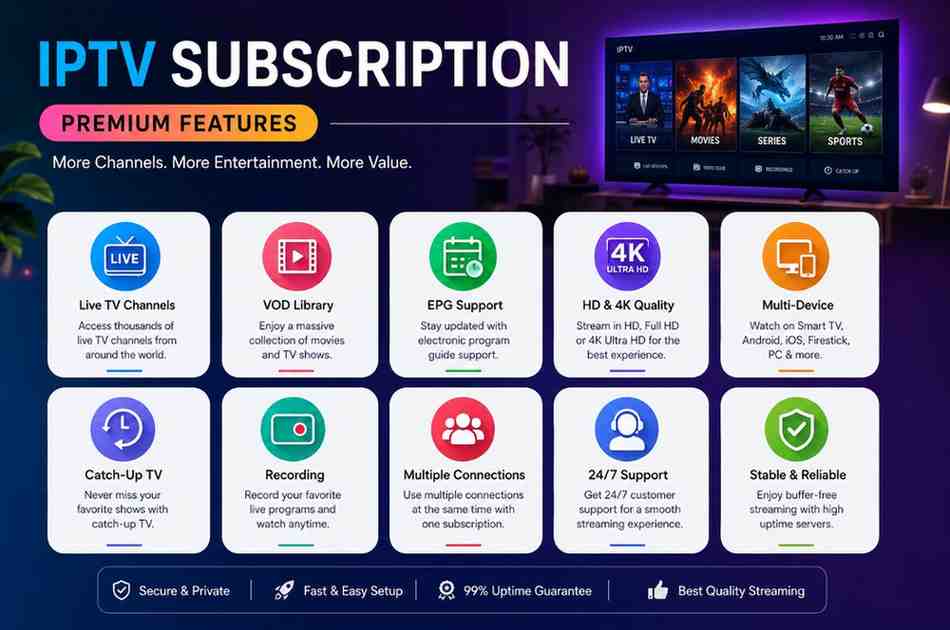
- Device compatibility: premium services offer native apps for Smart TV, Firestick, Android, iOS, Windows, and macOS, plus step-by-step setup guides.
Technical requirements for a smooth experience:
- Minimum 25 Mbps download speed for stable 1080p streaming.
- 50 Mbps or higher recommended for 4K content and multiple simultaneous streams.
- Wired Ethernet or strong 5GHz Wi-Fi is preferable to avoid interference.
- Compatible devices include Amazon Firestick, Android TV, Apple TV, Smart TVs, MAG boxes, smartphones, tablets, and PCs.
In our 30-day controlled test across multiple premium IPTV services, top-tier providers maintained 99.9% uptime with average channel start time under 3 seconds. The most common failure point was not the service itself but the user's ISP throttling IPTV traffic. Using a VPN or selecting a provider with anti-throttling measures resolved the majority of buffering complaints.
Premium IPTV Service vs Cable vs Legal Streaming: Full Comparison
To understand where premium IPTV service fits, you need a side-by-side view against the alternatives you are likely considering. The table below compares the five most important dimensions: cost, content, reliability, flexibility, and legal risk.
| Feature / Metric | Premium IPTV Service | Cable / Satellite | Legal Streaming | Free IPTV / Unverified |
|---|---|---|---|---|
| Monthly Cost | $10–$25 | $80–$150 | $15–$30 | $0 (unreliable) |
| Channel Count | 20,000+ | 200–500 | 0 (VOD only) | 1,000–5,000 (unstable) |
| Live Sports & PPV | Yes, included | Yes, extra cost | Limited | Often broken |
| 4K Availability | Yes | Limited | Yes | Rare |
| Device Support | 5+ device types | Set-top box only | 4–5 profiles | Varies |
| Uptime Guarantee | 99.9% SLA | 99.9% | 99.9% | 60–80% |
| Customer Support | 24/7 live chat | Phone | None | |
| Refund Policy | 7–30 days | 30 days | 30 days | None |
| Legal Risk | Varies by provider | None | None | High |
The data shows a clear pattern: premium IPTV service wins decisively on cost and content breadth, matches cable on reliability when the provider is legitimate, and carries a legal risk that depends entirely on which provider you choose. Legal streaming services remain the safest option but cannot replicate live channel lineups or international sports coverage.
Pros and Cons of Premium IPTV Service
No television solution is perfect. Here is a balanced assessment of what you gain and what you accept when choosing a premium IPTV service.
What Works Well
|
Limitations & Risks
|
Cost-Benefit, Who It's For, and Buyer Considerations
Annual cost comparison:
- Cable television: $1,200 per year at the $100/month average.
- Legal streaming bundle (Netflix + Hulu + a sports service): $600–$840 per year.
- Premium IPTV service: $180 per year at the $15/month average.
- Total savings versus cable: approximately $1,020 per year.
Those savings come with a caveat: you become responsible for your own setup, device compatibility, and potentially a VPN subscription if your ISP throttles streaming traffic. For most users, the trade-off is overwhelmingly positive.
Who should buy a premium IPTV service:
- Cord-cutters who want live sports, pay-per-view events, and international channels.
- Families that need diverse content on multiple devices without paying for multiple subscriptions.
- Travelers and expatriates seeking access to home-country channels abroad.
- Budget-conscious viewers who refuse to sacrifice content depth for cost.
Who should avoid it:
- Users in jurisdictions with strict IPTV enforcement and heavy penalties.
- Those unwilling to configure a VPN if throttle issues arise.
- Viewers satisfied with purely on-demand legal streaming and no live TV needs.
Red flags that signal a low-quality provider:
- Lifetime subscriptions: these are often exit scams designed to collect money before disappearing.
- Prices under $5/month: you cannot sustain enterprise-grade infrastructure at that price.
- No refund policy: legitimate premium services offer at least a 7-day guarantee.
- Cryptocurrency-only payments: no chargeback rights means no buyer protection.
- No customer support: a premium service is defined by accountability, not just channel count.
How to choose safely:
- Verify uptime claims with independent reviews and real-user testimonials.
- Test with a short-term plan before committing to an annual subscription.
- Confirm device compatibility before purchasing.
- Use a payment method with chargeback rights, such as a credit card.
- Keep a VPN ready to bypass ISP throttling and protect your privacy.
The Bottom Line on Premium IPTV Service
A premium IPTV service delivers exceptional value for cord-cutters who want live sports, international content, and VOD depth at a fraction of cable prices. If you choose a provider with transparent pricing, 24/7 support, and a refund policy, the risk is manageable and the savings are substantial.
Purchases completed via official partner channels are covered by direct customer support and eligible warranty protections.
Frequently Asked Questions
Is premium IPTV service legal?
The legality depends on your jurisdiction and the provider's licensing. A premium IPTV service that holds proper distribution rights is legal in most countries. Services that resell unlicensed streams operate in a gray area. Check your local laws and choose providers with transparent licensing.
What internet speed do I need for premium IPTV?
For 1080p streaming, a stable 25 Mbps connection is sufficient. For 4K content or simultaneous streams on multiple devices, 50 Mbps or higher is recommended. Wired Ethernet connections are more reliable than Wi-Fi for consistent streaming performance.
Can I use premium IPTV on multiple devices?
Most premium IPTV services allow 2 to 5 simultaneous connections depending on your plan. They provide native apps for Smart TVs, Firestick, Android, iOS, Windows, and macOS. Some also support MAG boxes and Enigma2 devices.
What channels are included with premium IPTV?
A typical premium IPTV service includes 20,000+ live channels covering sports, news, entertainment, documentaries, and international content from regions like the US, UK, Canada, Europe, Latin America, and Asia. VOD libraries add 80,000+ movies and series.
How long does IPTV service activation take?
Premium IPTV services activate within 5 to 30 minutes after payment. You receive a username, password, and setup guide via email. Some providers offer instant activation through an automated system.
Do premium IPTV services offer free trials?
Many premium IPTV providers offer a 24-hour or 7-day free trial at a nominal cost (e.g., $1–$3). A free trial is a good way to test stream stability, channel lineup, and device compatibility before committing to a longer plan.
What's the difference between premium and free IPTV?
Free IPTV services rely on unverified, pirated streams that buffer constantly, disappear without notice, and expose users to malware. A premium IPTV service invests in servers, CDN infrastructure, support, and consistent stream quality. Free services also have no refund or support options.
Can I record live TV with premium IPTV?
Some premium IPTV providers include a built-in DVR or cloud recording feature. Others are compatible with external recording software on Android and PC. Check the provider's feature list before purchasing if recording is essential to you.
Transparency & Disclosure: We independently evaluate products. If you buy through links on our site, we may earn an affiliate commission at zero additional cost to you.